
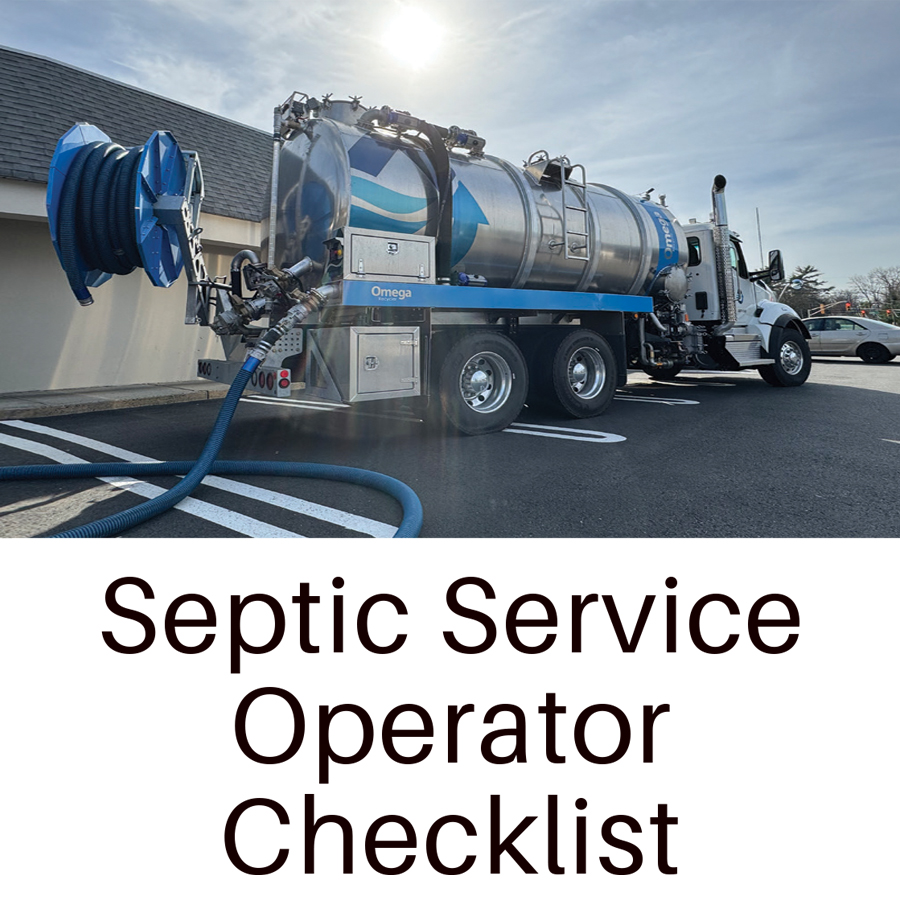
What’s the best way for any smart, busy person to get anything done professionally or personally? Use a good checklist. Here’s one recommended for Septic Service Operators to use in updating your existing checklist, or as a training module for your new technicians. Or, you can use all or parts of it to modify your information handouts to customers to help give them at least a general understanding of the major steps of your service process.
Septic Service Process Checklist
The standard septic service process requires preparation before leaving the shop to go out on the service call. At the service location, the process involves general assessment of conditions at the customer’s site, an evaluation of the septic tank, other components, and the drainfield (leach field). Then, the service on the system is performed, a report of the work is prepared and presented to the customer. Finally, the technician provides relevant advice to the customer and obtains the customer’s signature on the work report.
Here’s what the sequential process looks like, broken down into a checklist:
Prep for the Service Call
Check the account information:
- Review pumping records, previous service calls, and other details of the account history.
- Check the logistics, like travel time, road issues, property access, equipment access.
- Confirm the name of the current property owner and the cause of the service request.
- Contact the customer regarding past and current problems, like drain backup, odor.
Safety steps:
- Load all PPE, gas monitor, sludge sticks, scum sticks, and other necessary safety equipment and tools.
- Confirm your truck has the amount of hose length needed from the vehicle to the tank access point.
- Communicate with the customer about required measures to ensure worker and occupant safety during and after work on his/her property.
At the Service Site
Assess the customer’s site:
- Locate the access point for the septic tank and the area of the drainfield.
- Identify all obstructions to septic system access, such as vehicles parked in the workspace, fences, trees, recreational equipment, decks, etc., that are impediments to safe and efficient performance of service.
- Mark your work area with highly visible indicators. Put up safety barricades to discourage people from entering and reduce the risk of accidents.
Examine the access to the septic tank:
- Dig to access the septic tank lid (if applicable).
- Remove dirt, leaves, etc. from digging off the lid top to keep these from falling down into the septic tank.
- Be careful to avoid inhaling toxic fumes when opening the septic tank. Never enter the septic tank, due to the extreme health and safety risk.
Examine the inside of the tank:
- Tank structure: Inspect the tank walls and lid for leaks, cracks, or other issues that may threaten the functioning of the system.
- Baffles: Inspect the baffles (tees) for inlet and outlet, and repair any damage, and remedy any obstructions.
- Liquid waste: Ensure that the level is near the outlet but not over it. Excessively high liquid levels may be due to a pipe obstruction or drainfield problem.
- Sludge and scum: Measure the sludge and scum layers to see if pumping is advisable. If one or both layers are thicker than recommended, advise the customer to approve pumping.
Pumping process (if applicable):
- Use the suction hose to break the sludge layer apart and extract all the solids, chunks of floating scum, and liquid from the tank.
- Pump the tank out entirely, to improve its functional efficiency.
Filter examination:
- Check for clogs in the effluent filter (if applicable).
- Clean out or replace the filter (if needed).
Drainfield assessment:
- Examine the drainfield. Note spots with saturated soil, standing water, unusually lush grass, or other signs of possible septic system failure.
- Note spots on the drainfield with actually visible effluent matter.
- Probe the drainfield surface to locate areas of saturation.
- Note any trees, bushes, or other growth with intrusive roots by the drainfield.
Examine the distribution box:
- Inspect the distribution box to ensure that its structure is in good condition, free from leaks or cracks.
- Check to ensure an even and sufficient flow of effluent across all the drain lines.
Inspect design-specific components:
- Pump septic systems: Examine alarms, float switches, filters, baffles, and other relevant accessories. Test these (if applicable) for proper and unimpeded functioning.
- Aerobic septic systems: Examine the aerator, air filter, diffusers, risers, lids, and other applicable components.
Documentation:
- Record the details of your septic system examination, such as sludge and scum measurements, equipment or drainfield functional issues.
- Record information on the services you provided, such as the date, the work performed, like repair(s), pumping, etc., and any key discoveries you made from your inspections of the system components.
Cleanup of work area:
- Make sure your workspace is returned to the same condition as when you arrived on the site. Cover up the accesses to the tank with soil, as applicable, etc.
- Clean and store all equipment and tools you have used appropriately for transport.
Customer education and report delivery sign-off:
- Review with your customer the detailed documentation of your findings and service performed.
- Explain septic system preservation best practices, like appropriate waste disposal, avoiding parking vehicles or using heavy equipment on the drainfield.
- Emphasize timely equipment maintenance to protect the health of the occupants, longevity of the septic system, and the owner’s property investment.
- Advise on the dual benefits of practicing water conservation for helping the environment and reducing wear and tear on the septic system.
- Have your customer sign the service report to acknowledge their awareness of you working at their property.
SAFETY PROCEDURES
Of course, in addition to the particular safety steps specified above, adherence to all internal company safety policies and procedures is enforced. Further, compliance with OSHA, and local, state, and federal regulatory requirements is prioritized throughout all phases of the service process.
Why Follow a Checklist of Protocols?
At some point, we learn the truth that our memories are actually not perfect after all and that we’re actually just human, like everybody else. We will also discover that we are vulnerable to occasional errors of omission, like everybody else. Especially when we’re doing well, succeeding, working fast, moving smoothly, you know, being flawless, functioning in the zone.
That’s when they get you — those realities that expose the need for even the best of the best in their profession to use the sensible tools prescribed for ensuring consistent quality. That’s where a good checklist can be very handy.